


5 Forklift Specifications That Should Influence Your Warehouse Rack Design:
Forklifts in Warehouses Often Overlooked in Racking Design Process
When planning a warehouse pallet racking storage system, discussions typically focus on pallet loads, storage density, and building dimensions. But one critical factor often overlooked early in the warehouse rack design process is the forklift itself.
Forklifts and racking systems must work together as a complete storage solution. The type of lift truck operating in the facility will directly influence rack height, aisle width, load placement, and even the type of racking system that makes the most sense.
Ignoring forklift specifications during the warehouse rack design phase can lead to inefficient layouts, limited storage capacity, or safety risks. Before finalizing your rack design, here are five forklift specifications that should always be considered.
1. Maximum Lift Height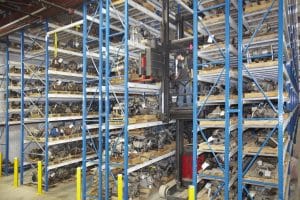
A forklift’s maximum lift height determines how high operators can safely place and retrieve loads from the rack.
This measurement directly influences the maximum number of rack beam levels a warehouse can support. If the racking system is designed taller than the forklift can reach, valuable vertical storage space may go unused.
Lift height also affects necessary clearances for:
-
Lighting
-
Roof structures
-
HVAC systems
Designing warehouse racking to match forklift capabilities ensures the facility fully utilizes its available vertical space.
2. Load Capacity at Height
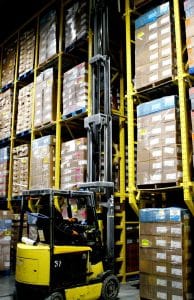 Forklift capacity ratings change depending on how high the load is lifted and the load center distance. While a forklift may be rated to handle a certain weight at ground level, that capacity often decreases significantly at higher elevations. When designing a system with pushback racking, the push force of the forklift is also very important. As a lift extends its mast higher, it gives less push force, so both lift and pushback/load must be compatible in order to work as needed.
This has several implications for warehouse rack design:
-
Upper rack levels may require lighter pallet loads
-
Rack beams must be selected to support the intended load weights
-
Pallet placement strategies may need to account for reduced lift capacity, especially in pushback scenarios
Understanding these limits helps ensure both the racking system and lift equipment operate within safe parameters.
3. Turning Radius
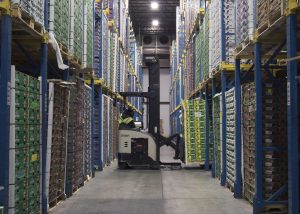
A forklift’s turning radius plays a major role in determining aisle width requirements, which directly impacts storage density.
Different lift trucks require dramatically different aisle widths:
-
Counterbalance forklifts typically require 12–14 foot aisles
-
Reach trucks may operate in 8–10 foot aisles
-
Very Narrow Aisle (VNA) trucks can work in 6 foot aisles or less
The narrower the aisle, the more racking can be installed within the same building footprint. However, narrower aisles also require specialized lift equipment and operational planning.
Selecting the right forklift type can dramatically improve storage capacity without expanding the warehouse.
4. Fork Length and Pallet Handling
Fork length must align with the pallet sizes and storage configuration used in the warehouse.
Improperly sized forks can cause issues when placing loads into rack bays. For example:
-
Forks that are too short may not fully support pallet loads
-
Forks that are too long can strike rack uprights or other pallets
Fork length also influences which racking systems are appropriate, such as:
-
Selective pallet rack
-
Push-back rack
Proper alignment between fork dimensions and warehouse rack design helps prevent product damage and improves operator efficiency.
5. Mast Height (Collapsed Height)
While lift height determines how high a forklift can reach, collapsed mast height determines where the forklift can travel when the mast is lowered.
This specification is especially important in facilities with:
-
Low ceiling areas
-
Dock doors
-
Mezzanines
-
Conveyor systems or overhead obstructions
If the forklift mast is too tall when lowered, it may restrict access to certain parts of the warehouse. This can affect traffic flow and operational efficiency.
Planning rack layout with forklift mast height in mind helps ensure smooth movement throughout the facility.
Designing Warehouse Racking and Lift Equipment as a Complete System
Warehouse racking systems should never be designed in isolation. Forklifts, pallets, loads, and building constraints must all work together to create a safe and efficient storage environment.
By considering forklift specifications early in the design process, warehouse operators can:
-
Maximize storage density
-
Improve operational efficiency
-
Reduce product and equipment damage
-
Maintain safe material handling practices
Working with experienced rack manufacturers and system designers ensures that both the racking system and lift equipment are properly aligned with your facility’s operational needs. If you’re looking for a partner to tackle your warehouse rack design, request a quote from Steel King today.
SOLUTIONS FOR EVERY INDUSTRY.
 Agriculture
 Automotive
 Construction Materials
 Cold Storage
 Ecommerce
 Food & Beverage
 Manufacturing
 Pharma
 Retail
 Wholesale/B2B
 3PL
3PLQuestions? Contact UsContact Us 