


The Hidden Cost of Pallet Rack Damage, Part 2: Why Better Rack Design Delivers Long-Term ROI
In Part 1 of this series, we explored how pallet rack damage affects warehouse operations through repair costs, lost storage capacity, downtime and increased safety exposure. Those hidden expenses often exceed the original cost of the damaged component.
 Now the question becomes: How can those costs be reduced?
The answer starts with pallet rack design. In Part 2, we examine how engineering decisions influence impact resistance, durability and maintenance requirements—and why evaluating total cost of ownership (TCO) provides a more accurate picture of long-term value than comparing purchase prices alone.
How Does Pallet Rack Design Impact Durability and Maintenance?
Not all pallet rack systems respond to forklift impacts in the same way.
The steel gauge and dimensions of the components matter, but so does the design of the structural members, connections, bracing and overall configuration.
“I can understand how warehouse managers may want to reduce the initial cost of a racking solution for their warehouse project, but sometimes they cut so much out of the racking, that it becomes a detriment to the long term costs of the racking,” says Dan Wierzba, Central Inside Sales Manager at Steel King Industries and a member of the Rack Manufacturers Institute (RMI). “By including some lower budget items like reinforcements, column protectors or our unique Column Core, the lifespan of the racking system can be greatly extended, reducing the total cost of ownership over the lifetime of the racking.”
 The Steel King Closed-Tube Advantage
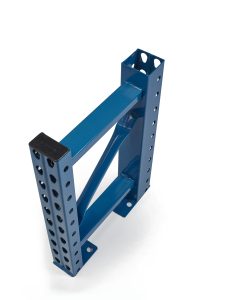
Steel King’s SK2000 and SK2500 pallet rack systems use closed tubular uprights and braces rather than the open-back configuration common in many roll-formed rack systems.
Independent engineering testing has shown that Steel King’s closed-tube design provides greater impact strength and twist resistance compared with open-back columns:
- 250% greater front-impact strength
- 68% greater side-impact strength
- 44 times greater twist resistance
Why does that matter? Because impact resistance isn’t just a safety feature. It can also be a cost-control feature. A rack system that is better able to withstand everyday impacts has the potential to reduce damage frequency, extend service life and reduce the maintenance burden over time.
How to Calculate the Total Cost of Pallet Rack Damage
When comparing different rack systems, it can be helpful to move beyond the initial purchase price and estimate the potential lifecycle costs. A simple calculation might look like this:
Total Pallet Rack Damage Cost = Repair Costs + Lost Capacity + Downtime + Additional Labor + Inventory Disruption + Risk Exposure
For example, suppose a warehouse experiences 10 rack damage incidents per year. If the average direct repair cost is $750, that’s:
- Direct Repair Costs: 10 × $750 = $7,500 per year
But suppose each incident also results in:
-
- Additional Labor & Handling: $500 per incident (10 x $500 = $5,000)
- Lost Productivity & Downtime: $750 per incident (10 x $750 = $7,500)
- Temporary Storage & Capacity Loss: $500 per incident (10 x $500 = $5,000)
Total Annual Impact: $7,500 + $5,000 + $7,500 + $5,000 = $25,000 per year
Over 10 years, that’s potentially $250,000 in cumulative costs—before considering inflation, a major rack incident, inventory loss or an increase in damage frequency.
The numbers will vary significantly from facility to facility, and the point isn’t to predict an exact cost. It’s to demonstrate why the initial price of the rack doesn’t tell the whole story.
Comparing Total Cost of Ownership
When comparing two pallet rack systems, purchasing teams often start with a simple question: Which rack costs less?
A better question may be: Which rack costs less to own?
Consider two systems:
- System A: Lower initial purchase price, but more susceptible to forklift impact and potentially higher repair frequency.
- System B: Higher initial purchase price, but greater impact resistance and potentially lower repair and maintenance costs.
If System B costs $50,000 more initially but reduces annual repair, downtime and capacity-related costs by $10,000, the additional investment could be recovered in approximately five years.
$50,000 ÷ $10,000 annual savings = 5-year payback
After that, the additional durability continues to generate value. This is the basic principle behind total cost of ownership.
The cheapest rack isn’t necessarily the rack with the lowest cost.
Key Questions to Calculate the Cost of Pallet Rack Failure
Pallet racking is an important piece of infrastructure in a warehouse or distribution center. It supports inventory, influences material flow and can affect how efficiently a facility uses its available space. That makes rack durability an essential operational consideration, much more than just a product feature.
When evaluating a pallet rack system, consider asking:
- How frequently does this operation experience rack impacts?
- How much does a typical pallet rack repair cost?
- How many pallet positions are lost during a repair?
- What is the hourly cost of operational downtime?
- How much labor is required to relocate inventory?
- How would a damaged rack affect automated equipment?
- What is the expected service life of the system?
- How does the rack’s impact resistance compare with other designs?
- What is the projected total cost of ownership over 10, 15, or 20 years?
These questions can change the purchasing conversation from “What’s the price per bay?” to “What’s the value of the system over its useful life?”
The ROI of Warehouse Durability and Impact Resistance
Rack damage is inevitable in many warehouse environments. The goal isn’t necessarily to eliminate every impact, but rather to reduce the frequency and severity of damage—and minimize the cost when impacts occur.
That starts with proper pallet rack design, operator training, regular inspections and appropriate rack protection. But it also starts with selecting a rack system engineered for the environment in which it will operate.
Steel King industrial steel pallet rack is designed to withstand the demands of daily warehouse operations, helping reduce risks, downtime and maintenance costs.
For operations that experience frequent forklift traffic or require enhanced impact resistance, the design of the rack itself can be an important part of the equation. Because the real cost of pallet racking isn’t what you pay for it on day one, it’s what the system costs you—or saves you—for years afterward.
Ready to Evaluate Your Rack’s Total Cost of Ownership?
Warehouse operators can’t eliminate every forklift impact. But they can choose storage systems engineered to better withstand the realities of daily operations.
When evaluating pallet racking, the conversation shouldn’t stop at the purchase price. The more meaningful question is: Which system will deliver the lowest total cost of ownership over the next 10, 15 or 20 years?
By considering durability, impact resistance, maintenance requirements and operational continuity together, organizations can make investments that improve safety, reduce lifecycle costs and maximize long-term ROI.
Contact Steel King to learn more about designing a pallet racking system for long-term performance.
For more warehouse design insights and engineered storage solutions, visit Steel King Resources Blog.
SOLUTIONS FOR EVERY INDUSTRY.
 Agriculture
 Automotive
 Construction Materials
 Cold Storage
 Ecommerce
 Food & Beverage
 Manufacturing
 Pharma
 Retail
 Wholesale/B2B
 3PL
3PLQuestions? Contact UsContact Us 