


Why a Professional Engineer (PE) Stamp Matters in Rack System Design
Behind every safe, efficient storage system is a significant amount of engineering
Warehouse racking may look straightforward from the floor level, but behind every safe, efficient storage system is a significant amount of engineering. As warehouse operations become more complex — with taller racks, heavier loads, automation, seismic requirements, and evolving fire codes — having a rack system reviewed and approved by a licensed Professional Engineer (PE) is becoming increasingly important.
According to the National Society of Professional Engineers, “A PE is an engineering professional who has earned a license to practice engineering. To become licensed, engineers must complete a four-year college degree, work under a Professional Engineer for at least four years, pass two intensive competency exams and receive a license from their state’s licensure board. Then, to retain their licenses, PEs must continually maintain and improve their skills throughout their careers.”
The added layer of assurance that warehouse operators, distributors, and facility managers get from a racking solution with a PE stamp means the racking system has been engineered to meet applicable building codes, safety standards, and operational requirements.
What Is a PE Stamp in Warehouse Racking?
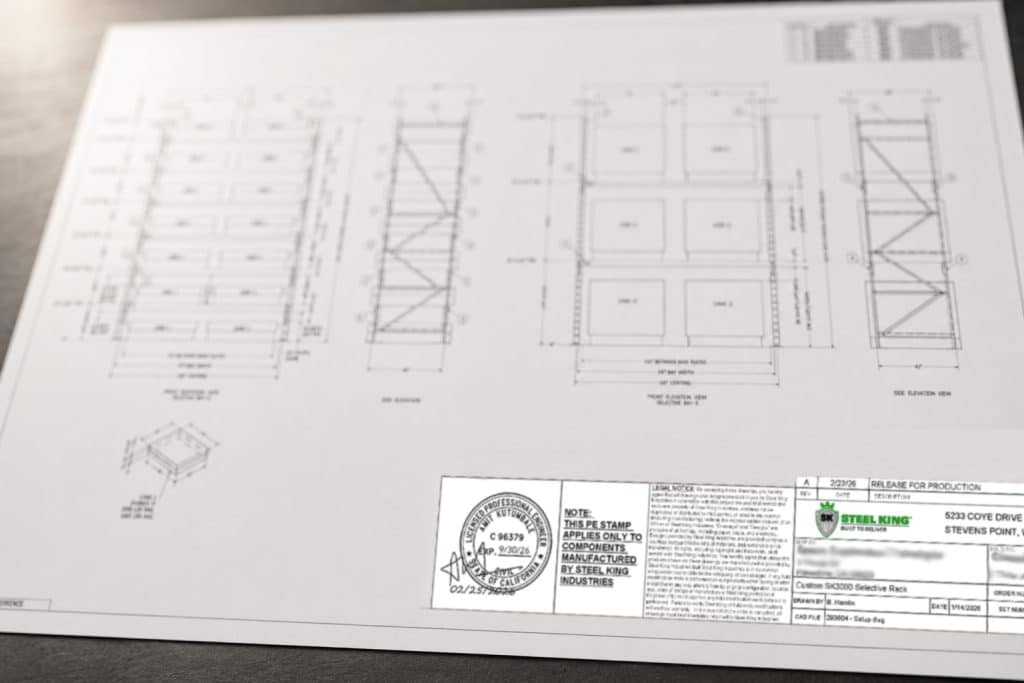 A Professional Engineer stamp signifies that a licensed engineer has reviewed and approved the structural design documents for a project. In pallet racking applications, this means the rack system has been evaluated for factors such as:
- Load capacities
- Seismic requirements
- Wind or snow loads for outdoor systems
- Building code compliance
- Floor slab interaction
- Structural stability
- Equipment interface requirements
- Fire and life safety considerations
Because industrial storage racks are often classified as “building-like structures” under the International Building Code (IBC), engineered review is frequently required — especially for non-standard applications.
Why Modern Warehouses Require Engineered Rack Systems
Years ago, many warehouses relied on standard “quick-ship” rack systems. Today’s distribution environments are very different. Facilities are pushing higher cube utilization, implementing automation, increasing SKU counts, and operating in environments ranging from cold storage to seismic regions. Those variables can dramatically impact rack design.
According to Steel King engineering resources, factors such as seismic activity, slab strength, forklift type, product weight, building clearances, and fire code requirements all influence the final engineering of a rack system. “There are many requirements and considerations that we have to factor in that go beyond the engineered rack itself,” said Vik Verma, Senior Engineer at Steel King.
A licensed engineer helps ensure those factors are properly accounted for before installation begins.
How PE-Stamped Rack Design Reduces Operational Risk
One of the biggest advantages of a PE-stamped rack design is risk reduction.
Warehouse racks are subjected to constant stress from pallet loads, forklift interaction, impacts, and operational changes over time. Even seemingly minor modifications — such as removing beam levels, changing pallet configurations, or converting double-row racks into single-row systems — can significantly affect load capacities.
A professionally engineered design helps warehouse operators avoid:
- Overloaded rack systems
- Improper anchoring
- Inadequate seismic protection
- Unsafe modifications
- Compliance issues during inspections
- Costly retrofits after installation
In many jurisdictions, engineered drawings may also be required to obtain permits or satisfy insurance requirements.
Meeting Seismic Compliance with a PE Stamp
 Seismic design is one of the clearest examples of why professional engineering oversight matters.
Rack systems installed in seismic regions must comply with evolving building codes and seismic design categories. Even facilities outside traditionally high-risk earthquake zones are increasingly being affected by stricter seismic requirements.
A PE evaluates:
- Seismic forces acting on the structure
- Anchor bolt requirements
- Rack-to-building clearances
- System stability under lateral loading
- Interaction between automation equipment and rack structures
Without proper engineering, facilities risk code violations, failed inspections, or unsafe rack performance during seismic events.
Outdoor Racking Faces Additional Engineering Issues
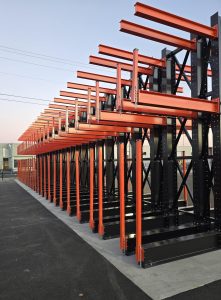 While seismic design for pallet racking is a great example of the value of professional engineering oversight, deploying pallet racking outdoors creates an entirely unique set of circumstances where a safe, efficient storage system requires a significant amount of engineering. The outdoor environment introduces rain, snow, wind, UV exposure, moisture, freeze-thaw cycles and other challenges that indoor systems simply weren’t engineered to withstand. Designing engineered pallet rack systems specifically for outdoor use helps ensure long lifespan, structural integrity and safety for both inventory and personnel. See more about this in a previous Steel King blog: ‘Outdoor Racking: Pallet Rack Design for Outdoor Storage’.
Supporting Warehouse Automation and High-Density Storage
Modern warehouse systems often include:
- AS/RS systems
- Pick modules
- Elevated work platforms
- Push-back and pallet flow systems
- Semi-automated shuttle systems
- High-density storage layouts
These applications require far tighter tolerances and more advanced structural analysis than traditional selective rack. Automated systems, in particular, depend on rack structures remaining straight, plumb, and structurally rigid.
Professional engineering review helps ensure the racking integrates properly with automation equipment while maintaining safe operating conditions.
Why Documentation Matters Long After Installation
Engineered rack drawings are not just valuable during installation — they remain critical throughout the life of the warehouse.
Steel King notes that design drawings should remain on file and readily accessible for inspections, capacity verification, operational changes, and future system modifications.
Having PE-approved drawings available helps:
- Guide annual rack inspections
- Verify allowable load capacities
- Ensure repairs maintain structural integrity
- Support facility audits and compliance reviews
- Simplify future expansions or modifications
Without accurate drawings, facilities may need to hire engineers later to recreate documentation before changes can safely occur.
When to Work with Engineered Rack Experts
Not every rack application requires the same level of engineering. However, when facilities involve:
- Tall rack structures
- Heavy pallet loads
- Outdoor storage
- Cold storage environments
- Seismic regions
- Automation integration
- Specialized storage applications
- Complex permitting requirements
…working with a manufacturer that provides professional engineering expertise can help avoid significant operational and financial headaches later.
Steel King’s engineering-focused approach emphasizes designing rack systems around real operational demands — not simply fitting facilities into off-the-shelf solutions. From seismic considerations to automation integration and custom storage applications, engineered rack systems help facilities balance safety, compliance, durability, and long-term performance.
Engineering Confidence into Every Rack System
A pallet rack system is a major infrastructure investment that impacts safety, productivity, throughput, and long-term operational flexibility.
A Professional Engineer stamp provides confidence that the system has been reviewed to meet applicable structural and safety requirements before the first pallet is ever stored. In an era of increasingly complex warehouse operations, that level of engineering oversight is no longer a luxury — it’s an important part of building safer, more resilient distribution environments.
For warehouse operators evaluating new rack systems, expansions, or modifications, involving qualified engineering professionals early in the process can help prevent costly surprises and ensure the system performs as intended for years to come.
 At Steel King Industries, we take pride in our legacy of engineering excellence, rooted in more than 55 years of designing and manufacturing industry-leading material handling and storage solutions. At the heart of Steel King’s success is a seasoned team of engineers and designers dedicated to innovation, customization, and structural integrity, ensuring every product meets stringent quality and safety standards. Our in-house engineering expertise allows us to tailor solutions that improve operational efficiency across diverse industries while meeting the current building codes and standards.
Steel King has PE licenses in 41 states.
At Steel King, we help customers evaluate both current and future needs to determine the storage strategy that delivers the greatest long-term value.
Contact a Steel King expert — we’ll work with you to get the most out of your operation and engineer a system to optimize your storage needs.
For more warehouse design insights and engineered storage solutions, visit the Steel King Resources Blog.
SOLUTIONS FOR EVERY INDUSTRY.
 Agriculture
 Automotive
 Construction Materials
 Cold Storage
 Ecommerce
 Food & Beverage
 Manufacturing
 Pharma
 Retail
 Wholesale/B2B
 3PL
3PLQuestions? Contact UsContact Us 