


Steel King Takes Aggressive Approach to Complying with Building Code Updates in Warehouse Rack Design
Buyers Advised to Consider Changes When Comparing Quotes
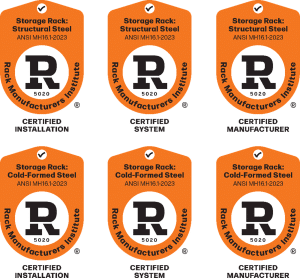
The R-Mark is the material handling industry’s most important indicator that a storage racking system was designed to withstand daily wear and tear and environmental factors, and to support intended loads. Now, with updates to building codes that local and state jurisdictions are adopting, the R-Mark program has been overhauled to reflect the new engineering requirements.
As manufacturers change their engineering method to comply with building code updates and to maintain R-Mark certification, rack system buyers need to know whether or not a project proposal is quoted reflecting the changes incorporated in MH16.1-2021/2023, says Amit Kutumbale, Director of Engineering at Steel King Industries.
“Considering the more rigorous engineering analysis requirements in the new RMI standard, a lower price may reflect less rigorous engineering, per MH16.1-2012,” he says. “Understanding the value of R-Mark certification — and specifically the new version tied to MH16.1-2021/2023 (adopted by IBC 2024) — helps ensure any comparison between suppliers is truly apples-to-apples.”
MH16.1-2023 is the R-Mark standard, and is nearly identical to the 2021 version, except in reference to seismic values. The update, along with those incorporated into the 2024 International Building Code (IBC 2024), are driving the change in how engineers approach warehouse rack design.
Adoption of IBC 2024 is happening gradually and varies significantly by location. As of early 2026, many states and municipalities had already begun using it, while others had announced target dates this year. Once a jurisdiction adopts IBC 2024, all new rack designs in that area must comply with the requirements of IBC 2024 and consequently MH16.1-2021/2023— including the newly mandated direct analysis method of engineering calculations.
Why Compliance Requires the Direct Analysis Method
Manufacturers who want R-Mark certification must now demonstrate they can perform rack calculations using the direct analysis method, conduct beam-post connection load testing at a third-party lab, submit calculations reviewed by an independent professional engineer, document their material procurement and quality control procedures, and provide annual attestations that those practices remain in place, Kutumbale notes.
Kutumbale notes that the direct analysis method addresses the stability issue accurately.
- It uses actual tested connection stiffnesses.
- It applies fictitious “notional loads” to simulate realistic column imperfections.
- It evaluates the entire racking system’s stability rather than individual members in isolation.
Steel King has positioned itself ahead of the curve on this new engineering method. Rather than conducting the minimum required number of beam-post connection tests (typically 3–4), our company has completed more than 100 such tests, with more in progress.
This comprehensive test data is incorporated into our engineering program to iterate a dynamic connection stiffness to moment relationship. This comprehensive testing and analysis allows Steel King engineers to determine actual connection stiffnesses for every beam-post combination, avoiding overly conservative assumptions that could lead to over-design.
Effective Length Method vs Direct Analysis Method
The direct analysis method replaces the effective length method that had been standard practice among racking engineers for decades. While both the 2021 and 2023 versions include major engineering changes compared to the older 2012 standard, the calculations for the effective length method were workable, but they did not adequately consider “stability analysis and second-order effects,” Kutumbale adds.
Second-order effects refer to the amplified demands that occur when an out-of-plumb structure deflects under axial load due to the eccentricity. When a loaded rack is pushed sideways by seismic or wind forces, or even when columns lean slightly due to manufacturing tolerances or installation imperfections, the axial load on those columns creates additional bending forces.
“Because the Ddirect Aanalysis Mmethod produces different load capacities and stability requirements than the older Eeffective Llength Mmethod, two rack designs that look similar on paper may not be engineered to the same standard,” he added. “A quote based on MH16.1‑2012 will almost always appear cheaper — not because it is more efficient, but because it is less rigorous. Buyers must confirm which method was used before comparing prices.”
Rethinking the Pallet Rack Capacity Calculator in Static Charts
“This is more technically accurate — but it also means that traditional upright capacity charts, which were based on individual column behavior, must be rethought,” he said.
Because the new code evaluates the stability of the entire racking system rather than individual parts in isolation, buyers can no longer rely on a generic pallet rack capacity calculator or static, isolated upright charts to guarantee safety. Capacity is now tied directly to the dynamic interaction of the specific components used.
“Staying ahead of code adoption timelines and investing in testing and engineering capability isn’t optional anymore,” Kutumbale says. “It’s the price of doing business in the modern rack industry.”
Steel King earned its updated R-Mark certifications in 2023. Buyers will note that the new R-Mark badge looks different from the old one, and that it now specifies whether the manufacturer is certified for cold-formed steel racks, structural steel racks, or both.
Working with an experienced rack manufacturer that understand the codes that apply to racking systems is key to your success. If you’re looking for a partner to tackle your warehouse rack design, request a quote from Steel King today.
SOLUTIONS FOR EVERY INDUSTRY.
 Agriculture
 Automotive
 Construction Materials
 Cold Storage
 Ecommerce
 Food & Beverage
 Manufacturing
 Pharma
 Retail
 Wholesale/B2B
 3PL
3PLQuestions? Contact UsContact Us 