


The Rack Is More Than Storage: Why Racking Matters in an AS/RS System
In Automated Warehouses, the Rack Becomes Part of the Machine
When most people think about an Automated Storage and Retrieval System (AS/RS), what they picture is the automation: cranes moving rapidly through aisles, conveyors transporting pallets, software directing inventory and sophisticated controls coordinating the entire operation.
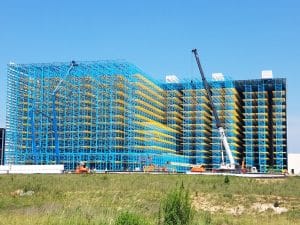 However, a component that is just as important to the performance of the system is the AS/RS racking. In an automated storage environment, racking is not simply a structure for holding pallets — it is an engineered component of the overall material handling system.
That distinction becomes increasingly important as warehouses move toward taller structures, greater storage density and faster automated movement. An AS/RS system is only as precise as the environment it operates in. The rack must be designed around the requirements of the automated system rather than treating automation as something that gets added to a conventional rack system.
Key Takeaway: An AS/RS system relies on structural racking engineered for extreme precision, tight dimensional tolerances, and dynamic load handling. Treating the AS/RS racking as an integrated machine component, rather than an afterthought, prevents operational downtime and costly retrofits.
Why is AS/RS Rack Different from Traditional Pallet Rack?
Traditional pallet rack is generally designed around the needs of forklifts and warehouse operators. A forklift needs enough aisle width to maneuver, and operators visually align pallets with beams. Some amount of movement and dimensional variation can be accommodated during normal operation.
Automated systems operate differently. In an AS/RS system, the crane or other automated handling equipment operates within very narrow clearances. The rack must provide the dimensional accuracy, structural stability and load capacity required by the equipment throughout the operating cycle.
Critical engineering considerations for AS/RS racking design include:
- Structural capacity, or the ability to support heavy static and dynamic loads continuously.
- Rack height and depth, or the vertical stability and structural integrity for high-bay storage.
- Beam deflection and upright stability, or the control of structural movement under varying load conditions.
- Dimensional tolerances, or the strict alignment limits required for high-speed automated equipment.
- Floor anchoring and seismic requirements, or the foundational tie-ins needed to withstand lateral forces.
- Equipment clearances, or precise aisle tolerances for cranes, shuttles, and transfer cars.
- System integration, or structural alignment with conveyors and other automated material-handling equipment.
The rack and automation cannot be designed independently.
Why Does Precision Become More Important as Height Increases?
One of the primary attractions of a unit-load AS/RS system is the ability to use vertical space.
As storage heights increase, however, structural considerations become more demanding.
Tall rack structures must remain stable and within the tight tolerances required by automated equipment. Small dimensional issues that might not create a significant problem in a conventional forklift application can become critical when equipment is operating automatically at significant height.
This is one reason high-strength structural steel is commonly used for demanding AS/RS racking applications.
How is Racking Part of the AS/RS System?
A successful automated storage and retrieval system installation requires coordination among the rack manufacturer, automation provider, integrator, building designer and other stakeholders.
The rack must accommodate the equipment, while the equipment must operate within the parameters established by the rack and facility design. This makes early coordination critical. Conveyors, cranes, transfer cars, robotic equipment and other components impose structural or dimensional requirements that need to be considered before the rack is manufactured. Adding those requirements after the fact can lead to costly modifications.
Why Should Engineering Come Before Automation?
Automation can dramatically improve storage density, throughput and labor efficiency. But those benefits depend on the infrastructure supporting it.
The right question isn’t simply, “What automation should we install?”
It is also: “What storage structure will allow that automation to perform reliably?”
That is where rack engineering becomes a critical part of the AS/RS conversation.
At Steel King, we believe the rack should be considered part of the automated system from the beginning—not an afterthought. When rack, automation and building design are engineered together, the result is a storage system designed for the demands of today’s automated warehouse and the requirements of tomorrow’s operation.
Ready to explore an AS/RS system? Contact Steel King to discuss your application.
For more warehouse design insights and engineered storage solutions, visit Steel King Resources Blog.
SOLUTIONS FOR EVERY INDUSTRY.
 Agriculture
 Automotive
 Construction Materials
 Cold Storage
 Ecommerce
 Food & Beverage
 Manufacturing
 Pharma
 Retail
 Wholesale/B2B
 3PL
Questions? Contact UsContact Us 