


Unit-Load AS/RS vs. Rack-Supported Buildings: What’s the Difference in an AS/RS Warehouse?
Two Approaches to Automated Pallet Storage
Automated storage and retrieval systems (AS/RS) have become an increasingly important tool for companies looking to increase storage density, improve throughput and reduce dependence on manual material handling. But “AS/RS” doesn’t describe just one type of facility.
For unit-load pallet applications, two approaches are commonly considered: an AS/RS installed inside a conventional building, or a rack-supported AS/RS building where the rack itself is an integral part of the facility structure.
Both AS/RS warehouse approaches provide highly automated, high-density storage. The primary difference lies in how the storage system and building integrate.
What Is Unit-Load AS/RS?
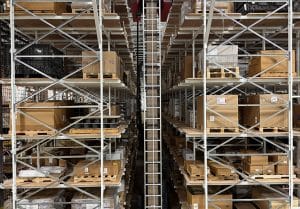
Unit-load AS/RS is designed to automatically store, handle, and retrieve palletized inventory loads using automated cranes operating within dedicated aisles.
Operating inside an AS/RS warehouse, this type of system moves pallets between storage positions and input/output locations, providing:
- High storage density
- Automated pallet movement
- Reduced forklift travel
- Improved inventory control
- Consistent storage and retrieval
- Better utilization of vertical space
In a conventional setup, the racking serves as an essential structural component of the storage system, but the facility itself is constructed independently of the racking.
What Is a Rack-Supported AS/RS Building?
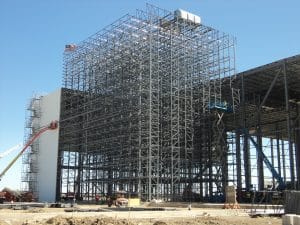
A rack-supported AS/RS building is an integrated facility where the storage rack acts as the primary structural frame supporting the roof, wall cladding, and exterior building envelope.
Instead of constructing a conventional building and then installing the storage rack inside it, the rack and building are engineered as a single unit. This approach is ideal for very tall, high-density facilities where maximizing cubic space utilization is a priority. Rack-supported structures can reach significant heights, allowing a facility to store more inventory vertically while minimizing the required land footprint.
Why Does Building Height Matters in an AS/RS Warehouse?
Building height matters because the economics of modern warehouse design are increasingly driven by cubic utilization rather than square footage alone.
Land costs, construction expenses, and environmental conditioning costs (especially in cold storage) make footprint efficiency essential. Going higher allows a facility to gain additional storage capacity without increasing its physical footprint proportionately. This makes rack-supported AS/RS particularly attractive for applications where vertical space is valuable.
Key Considerations when choosing an approach include:
- Building: Is a conventional building already available, or is this a new facility?
- Height: How much vertical storage capacity is required?
- Density: How many pallet positions are needed within the available footprint?
- Environment: Is the facility ambient, refrigerated or frozen?
- Construction: How will the building, rack and automation be coordinated?
- Future Growth: Does the design need to accommodate expansion or changing requirements?
There is no single answer that works for every facility.
Why Is Engineering Critical for a Rack-Supported Building?
Rack-supported AS/RS requires especially close coordination between structural engineering, rack design, automation and building construction.
Engineering is critical for a rack-supported building because the racking system must carry structural roof and wall loads in addition to the weight of stored inventory.
Because the rack serves as the building frame, external environmental factors – such as wind, seismic conditions, roof support, and building envelope requirements – must be co-engineered alongside the automated equipment and pallet load specifications.
How Do You Choose the Right AS/RS Approach?
Choosing the right AS/RS solution requires evaluating specific operational requirements rather than starting with a predetermined equipment design. For some operations, a conventional building with an integrated unit-load AS/RS may make the most sense. For others, particularly new high-density facilities, a rack-supported AS/RS building can provide significant advantages.
The key is understanding the differences early enough in the planning process to make the right decision.
Steel King works with customers and system partners to engineer structural rack solutions for demanding automated storage applications, including rack-supported buildings.
Planning a new automated storage facility? Start with the structure. Contact Steel King to discuss your application.
For more warehouse design insights and engineered storage solutions, visit Steel King Resources Blog.
SOLUTIONS FOR EVERY INDUSTRY.
 Agriculture
 Automotive
 Construction Materials
 Cold Storage
 Ecommerce
 Food & Beverage
 Manufacturing
 Pharma
 Retail
 Wholesale/B2B
 3PL
Questions? Contact UsContact Us 