


The Hidden Cost of Pallet Rack Damage, Part 1: Calculating the Real ROI of Impact-Resistant Racking
When most warehouse leaders evaluate pallet racking, they naturally focus on purchase price. But the true cost of a pallet rack system isn’t determined on installation day—it’s measured over years of operation.
In this two-part series, we examine how pallet rack damage affects the total cost of ownership of your storage system. Here in Part 1, we explore the often-overlooked financial consequences of rack damage, from repair expenses to lost storage capacity, operational disruptions and safety risks. Understanding these hidden costs is the first step toward making smarter long-term investment decisions.
Why Initial Pallet Rack Cost Doesn’t Tell the Whole Story may not be the least expensive rack
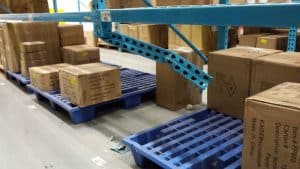
When evaluating a pallet racking system, the initial purchase price is usually easy to calculate. The costs that come later are harder to see.
- Forklift impacts and structural collisions
- Damaged uprights and replacement beams
- Lost pallet positions and reduced storage capacity
- Production interruptions and workflow delays
- Inventory that has to be relocated
- Time spent waiting for replacement components
- Safety and liability risks associated with a damaged rack system
These costs rerely appear on the original purchase order for the racking, yet they can have a significant impact on the total cost of ownership over the life of the system.
That’s why rack durability and impact resistance should be considered part of the ROI calculation when comparing pallet rack systems.
A rack system that costs slightly more upfront but withstands impacts better, requires fewer repairs and keeps more storage positions operational may deliver considerably more value over its service life.
Pallet Rack Damage Is More Than a Maintenance Problem
Forklift contact is one of the most common causes of pallet rack damage. Even an impact that appears minor can deform an upright or other structural component and potentially reduce the capacity of the system.
Steel King engineers have seen the consequences firsthand.
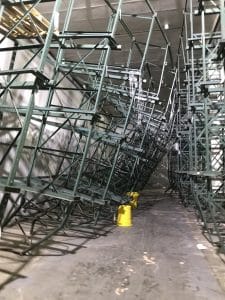 “Forklift impacts are the leading cause of rack damage,” says Dan Wierzba, Central Inside Sales Manager at Steel King Industries and a member of the Rack Manufacturers Institute (RMI). “Rack owners should conduct regular inspections to make sure nothing has been moved or disengaged.”
Once damage is identified, it needs to be evaluated and addressed. Steel King recommends that damaged components be replaced immediately and that compromised racks be unloaded when necessary.
OSHA also emphasizes maintaining storage racks and keeping aisles and passageways clear of hazards. The RMI’s (Rack Manufacturer’s Institute) guidance on pallet rack safety and inspection provides additional information on identifying and addressing damage. Proper forklift operation and operator training are also important components of preventing workplace incidents.
But the cost of that damage doesn’t stop with the replacement component. To understand the real financial impact, warehouse operators need to look at the entire cost of a rack damage event.
1. Direct Pallet Rack Repair Costs
The most visible cost of an incident is the physical pallet rack repair, which includes:
- Replacement uprights, beams, bracing, anchors and hardware
- Rack protection components
- Labor for dismantling and rebuilding
- Engineering or inspection services
- Freight for replacement components
- Equipment rental or installation costs
And a repair isn’t necessarily limited to the damaged component.
Rack damage may require a section of the system to be unloaded, inspected or temporarily taken out of service. In some cases, adjacent components need to be evaluated as well.
There’s also an important consideration when replacing rack components in that replacement parts should come from the original equipment manufacturer (OEM). Mixing components from different manufacturers can create fit, connection and load-capacity issues which may compromise the structural integrity of the system. (See this previous blog about mixing OEM equipment)
2. Lost Storage Capacity and Displaced Inventory
What happens to inventory when a damaged rack bay has to be unloaded? It has to go somewhere.
If replacement space isn’t available, pallets may end up on the floor, in another area of the warehouse or in temporary storage. That can reduce available storage capacity and create additional handling requirements.
Consider a simple example. A warehouse has a damaged upright that requires a four-bay section of rack to be taken out of service. Each bay holds four pallets at three beam levels.
That’s 48 pallet positions temporarily unavailable.
To mange displaced inventory, operations must often:
- Move product to another facility
- Rent temporary off-site storage space
- Increase pallet movements
- Reduce inventory levels
- Delay inboud shipments
- Store product on the floor
- Reduce available capacity for new orders
The financial impact depends on the operation, but the calculation is straightforward:
Lost pallet positions × cost/value per position × time out of service = total cost of lost capacity
3. Operational Downtime and Workflow Disruptions Have a Price
Rack repairs can also interrupt normal warehouse operations.
A damaged rack may need to be unloaded before repairs can begin. Aisles may need to be blocked off. Forklift traffic may have to be rerouted. Inventory may need to be temporarily relocated.
Even if the repair itself takes only a few hours, the operational disruption can last longer.
For warehouse operations leaders, the fundamental question is not just: “How much will this repair cost?”
It’s: “What does it cost us to have this storage location unavailable?”
Unplanned downtime could include lost throughput, additional labor, equipment utilization, overtime or delayed shipments.
4. Safety Risks and Liability Exposure
There is another cost that can’t be easily captured in a maintenance budget: risk.
A damaged rack has the potential to compromise structural capacity. If damage isn’t identified and addressed, the consequences can extend to falling product, rack collapse, worker injury and inventory loss.
Steel King’s paallet rack safety guidance emphasizes the importance of regularly inspecting rack systems and replacing damaged components. This is especially important in facilities storing:
- Heavy loads
- High-value inventory
- Hazardous materials
- Loads close to the rack’s rated capacity
- Products with high replacement or production costs
The potential cost of an incident can be far greater than the cost of preventing one. For finance and operations leaders, this is an important part of the ROI calculation—even though the financial value of avoiding a serious incident is difficult to quantify.
5. Compounded Risks in Automated Warehouses
Rack damage can become even more expensive in an automated warehouse.
Automated storage and retrieval systems (AS/RS), autonomous mobile robots (AMRs), automated guided vehicles (AGVs), and other automated equipment depend on the storage environment being consistent and predictable. A damaged rack can create problems beyond the rack itself.
If an impact causes a rack to move out of position, changes its geometry or compromises a structural component, the resulting issue can potentially affect automated equipment operating around or within the system. The more tightly integrated the storage and material-handling system, the more important rack integrity becomes.
Automation also changes the economics of downtime. When a manual operation loses a rack bay, workers may be able to work around it. In an automated system, a damaged rack or disrupted storage location could potentially interfere with a larger portion of the process.
Protecting Your Storage Investment
Pallet rack damage is rarely just a maintenance issue. As we’ve seen, the financial impact extends far beyond replacing a damaged upright or beam. Lost pallet positions, operational downtime, additional labor, inventory disruption and increased safety risks can quickly multiply the true cost of even a single forklift impact.
In Part 2, we’ll look at the other side of the equation: how the design of the rack itself influences long-term performance and why total cost of ownership—not initial purchase price—should guide every racking investment decision. We’ll also examine how impact-resistant rack design can deliver measurable ROI throughout the life of the system.
Contact Steel King to learn more about designing a pallet racking system for long-term performance.
For more warehouse design insights and engineered storage solutions, visit Steel King Resources Blog.
SOLUTIONS FOR EVERY INDUSTRY.
 Agriculture
 Automotive
 Construction Materials
 Cold Storage
 Ecommerce
 Food & Beverage
 Manufacturing
 Pharma
 Retail
 Wholesale/B2B
 3PL
3PLQuestions? Contact UsContact Us 