


Leadership, Legacy and the Future of Steel King
A King-Sized Conversation with Steel King Chairwoman Stacy Atherton
At Steel King, leadership has always meant more than managing operations or driving growth. It means building something durable — not just in the products the company manufactures, but in the culture, relationships, and reputation that define the company.
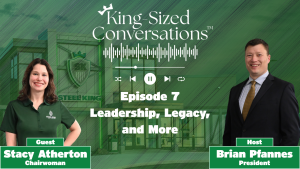
That mindset was front and center during a recent episode of King Sized Conversations, where Steel King Chairwoman Stacy Atherton joined host Brian Pfannes for a wide-ranging discussion on manufacturing leadership, mentorship, integrity, and the responsibility that comes with leading one of the most respected brands in the material handling industry. You can view the podcast here, or by clicking on the image. You can watch the full interview on YouTube, click the image above to view, or stream the episode on Spotify and other podcast platforms.
 More Than Manufacturing
When asked how she explains Steel King to someone unfamiliar with the material handling industry, Atherton kept it simple.
“We manufacture products for the material handling space, and our primary product line is industrial steel storage rack.”
But behind that straightforward answer is a deeper appreciation for manufacturing itself — something Atherton says has grown significantly during her eight years at Steel King.
“I have become such a manufacturing geek over the past eight years, and I love the fact that Steel King makes things.”
That passion reflects a broader reality across manufacturing today. Modern warehouse operations and supply chains depend on reliable, engineered infrastructure. From e-commerce fulfillment to retail distribution, pallet rack systems play a critical role in moving products safely and efficiently throughout North America.
Protecting a Legacy Brand
Steel King has built a reputation over decades as one of the premier names in industrial storage rack. Atherton emphasized that maintaining that reputation requires constant stewardship.
“I take a tremendous amount of pride in knowing that Steel King is viewed as the premier brand within the racking space.”
She also noted that strong reputations are difficult to build — and easy to lose.
Drawing from her early background in public relations, Atherton explained that protecting the Steel King brand means making decisions that support long-term trust with customers, employees, and industry partners alike.
“It’s incredibly important to me to protect it and to nourish it and steward it for the future and the next generation.”
That sense of pride extends well beyond the workplace. Atherton shared a story about her young daughter drawing the Steel King shield logo from memory after seeing it so often — a small but meaningful reminder of how deeply company culture can influence families and communities.
 Leadership Is Built Through Growth
One of the recurring themes throughout the conversation was the idea that leadership is not static.
Atherton described her leadership style as both “constant and evolving”, something grounded in authenticity and respect, but also shaped by continuous learning and self-improvement.
“I’m constantly learning. I’m constantly growing and facing my own growth areas and opportunities and saying, ‘How can I be better?’”
That willingness to evolve is something she believes separates strong manufacturing leadership from average management.
When asked whether great leaders are born or built, Atherton pointed to a combination of natural drive and intentional development.
“I think they’re more built, but there is an element of born.”
She explained that great leaders actively seek growth opportunities, embrace challenges, and remain willing to learn from others throughout their careers.
The Hardest Parts of Leadership
The discussion also explored the difficult realities that come with leadership responsibilities.
Atherton spoke candidly about the emotional weight of workforce reductions and difficult personnel decisions.
“It’s not just employee ID numbers, it’s real people with real lives and families and needs.”
She emphasized that leadership decisions should feel personal because they directly affect people’s lives. That perspective aligns closely with Steel King’s longstanding emphasis on treating employees with respect and maintaining a people-first culture.
Another leadership challenge Atherton highlighted was receiving difficult feedback.
“The things that are the hardest for us to hear are also often the things that are most important for us to hear.”
Rather than resisting criticism, she described feedback as a valuable opportunity for growth — even when it’s uncomfortable.
Why Mentorship Matters
Mentorship played a significant role throughout Atherton’s leadership journey, particularly as she transitioned into executive leadership.
She explained how mentorship needs evolve over time — from learning how to prepare for meetings early in a career to navigating organizational leadership and strategic decision-making later on.
Atherton credited several mentors for helping shape her growth, including former healthcare technology CEO Ann Finch, who provided guidance during Atherton’s transition into senior leadership.
“Having an outside perspective of someone who has gone through those things… is incredibly helpful.”
The conversation reinforced an important reality in manufacturing leadership: no leader succeeds alone. Strong organizations are built through collaboration, mentorship, and shared experience across generations of leaders.
 Integrity Still Matters Most
When asked to rank the importance of integrity, resilience, vision, and humility, Atherton placed integrity firmly at the top.
“Once you lose that, the rest of it almost doesn’t matter.”
She explained that trust is built through authenticity, honesty, and operating with integrity — especially during difficult conversations or challenging business decisions.
That trust, she noted, becomes extremely difficult to rebuild once broken.
The conversation highlighted how integrity continues to serve as a foundational value not only within Steel King leadership, but throughout the company’s broader culture and customer relationships.
Looking Toward the Future
As the discussion wrapped up, Atherton reflected on what she hopes Steel King becomes over the coming decades.
Rather than focusing solely on growth or market position, her vision centered on reputation and culture.
“I hope to take pride in the fact that our brand reputation is still top-notch. We have a reputation for taking care of our people and taking care of our customers and doing what we say we’re gonna do.”
That long-term perspective mirrors Steel King’s broader approach to manufacturing: building products — and relationships — designed to stand the test of time.
As warehouses evolve, automation expands, and supply chains continue changing, the manufacturing leadership principles discussed in this conversation remain highly relevant. Integrity, resilience, mentorship, and authenticity are not just executive buzzwords — they are the qualities that help companies adapt, grow, and continue earning trust generation after generation.
For more insights into warehouse operations, leadership, and engineered storage solutions, visit the Steel King Blog
SOLUTIONS FOR EVERY INDUSTRY.
 Agriculture
 Automotive
 Construction Materials
 Cold Storage
 Ecommerce
 Food & Beverage
 Manufacturing
 Pharma
 Retail
 Wholesale/B2B
 3PL
3PLQuestions? Contact UsContact Us 